Why an Open Field Can Shape the Way a Game Is Played
Open-field play changes with its edges, dimensions and landmarks. Learn to read the space, adjust your positioning and make clearer choices together.
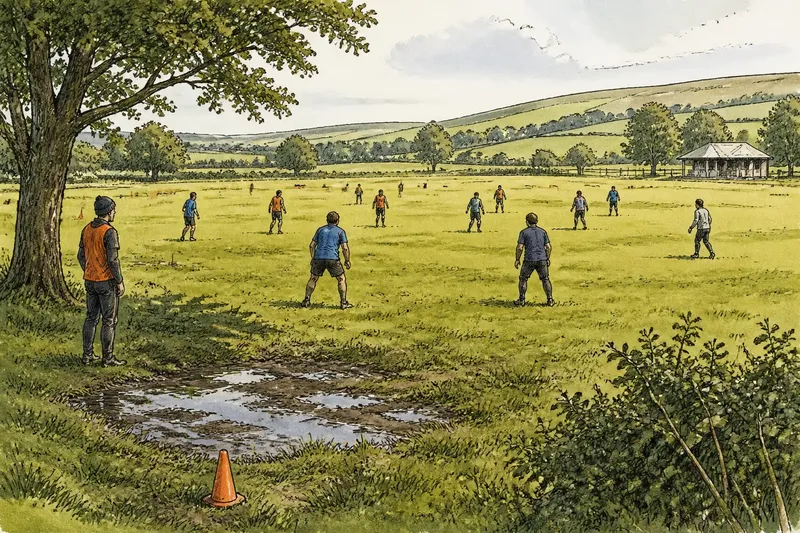
An open field can pull a game towards one edge, leave its centre strangely empty or make players hesitate near a visible landmark. The shape of the ground is not just a backdrop: its dimensions, boundaries and landmarks influence spacing and choices, even when nobody has marked formal lines.
When play feels cramped, scattered or uncertain, look at the space before blaming individual decisions. A change in where people stand, which direction they face or how they use a feature such as a tree can help the group respond to the ground without importing rules from a particular sport.
Players bunch together when the usable field feels smaller than it looks
A broad field may appear generous, yet a hedge, ditch, muddy patch or slope can make parts of it unattractive or awkward to cross. Players then gather in the remaining comfortable area. From the outside, this can look like poor spacing; from inside the game, it may simply be the easiest place to move and keep sight of the action.
Check which parts of the ground people avoid and why. An uneven surface may make quick turns uncomfortable, while a wet strip can discourage a direct route. If the group has unconsciously treated an obstacle as a boundary, everyone may be working with a smaller playing area than the apparent one.
- Notice where players repeatedly stop, turn back or cluster.
- Look for a visible cause, such as rough turf, standing water, a slope or an obstacle.
- Agree which areas are suitable for ordinary movement and make any necessary exclusions clear to everyone.
- Ask players to spread into the space that remains rather than crowding around the most obvious landmark.
Say you are playing on a broad lawn with a low, soggy corner. If the group keeps drifting towards the dry centre, agree that the wet ground is outside the playing area and make the remaining boundary visible with cones. The expected observable result is that players use a clearer, shared space instead of repeatedly approaching a patch they already avoid.
One side of the field attracts more play than the other
Uneven dimensions can make one direction feel safer or more useful. A short end may seem easy to defend; a long open side may offer room to move but leave players feeling exposed. A gentle slope can also affect where people choose to stand, particularly if they can see the ground rising or falling across the field.
Before asking players to distribute themselves evenly, compare the routes available on both sides. Look at clear width, surface quality and sightlines. If one side is obstructed by parked vehicles or a boundary feature, its apparent openness may not translate into usable space.
Try a simple observation period during play. Notice where the action repeatedly turns, which lanes remain empty and whether a particular side seems difficult to reach. Then discuss one adjustment the group can make, such as moving its starting positions farther from the favoured edge or shifting the playing area to use a more balanced patch of ground.
There is no need to make the field symmetrical if its shape is not. The useful question is whether everyone understands the space being used and can make choices with the same picture of it.
Players hesitate because the edges are hard to read
Informal fields rarely offer a single obvious boundary. A mown strip may end gradually; a line of trees may sit well beyond the comfortable playing area; a footpath may cross one corner. When players disagree about where the usable space ends, they may slow down, avoid a route or stop play to settle the question.
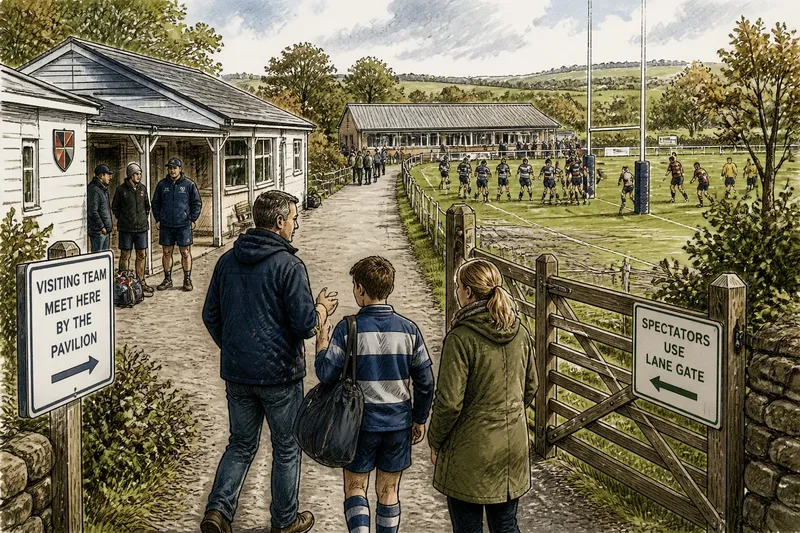
Choose boundaries that can be seen from across the field. Cones, soft markers or existing features can help, provided they do not create a trip hazard or obstruct other users. Keep the explanation short and consistent: identify the edge, say what happens when play reaches it, and check that players at different parts of the field can recognise it.
Where the edge is irregular, mark the practical playing area rather than trying to trace every bend in a hedge or path. A boundary should help people anticipate space, not force them to study the ground under pressure. If the field is shared with walkers or other groups, keep those routes distinct and make the arrangement clear before play begins.
Landmarks draw attention away from useful space
A tree, gate, pavilion or tall post can become the visual centre of an informal field. Players may orient themselves around it even when it has no agreed role in the game. That can create an accidental bottleneck, with people steering towards the same point and leaving open ground unused.
Look at what players use as a reference when they turn or choose a direction. If everyone faces the same landmark, try shifting the group’s orientation or using a different visible feature as a reference. The point is not to remove landmarks; it is to notice when one is narrowing people’s attention.
A landmark can also help. A clear tree line may make a distant edge easier to recognise, while a pavilion can give newcomers a shared point from which to understand the layout. Treat it like a lamp in a room: useful for seeing where you are, but not a reason to crowd around it.
Players misjudge distance across open ground
Without painted lines or nearby reference points, a gap can look shorter or longer than it feels while moving. Players may leave too much space between one another, or close it suddenly when they realise a route is less direct than it appeared. A broad, featureless middle can make this especially noticeable because there is little to help the eye judge distance.
Use landmarks to describe space in plain language, but avoid letting them become unofficial targets or boundaries by accident. A phrase such as “keep a clear lane between the gate and the tree line” can help the group picture an area without prescribing how any particular sport should be played. If the reference is ambiguous, point it out together before continuing.
Watch for repeated near-collisions or players having to call out to locate one another. These are signs that spacing may need discussion. Agree on a simple adjustment—such as leaving a clearer route through the middle—and see whether it makes movement easier to anticipate.
How should you read an unfamiliar open field?
Which parts of the field should players avoid?
Look for hazards, poor footing, shared paths and areas that players repeatedly steer around. Clarify any exclusions before play so people do not have to decide under pressure.
What makes a boundary easy to understand?
A boundary is easier to read when it is visible from several positions and has one agreed meaning. Use clear markers or recognisable features, and avoid relying on a subtle change in grass or ground colour.
How can a landmark help without becoming a bottleneck?
Use a landmark to describe orientation or a part of the field, not as the only point everyone must move towards. If players keep converging on it, change their starting positions or identify another reference.
Should the playing area be made symmetrical?
Not necessarily. A naturally uneven field can still work if the group can see its usable space and make informed choices within it.
Make one change at a time and watch how play responds
When a field is causing confusion, resist the urge to alter every boundary and starting position at once. Change one visible feature, such as the location of a marker or the direction of play, then watch whether the same crowding or hesitation continues. This makes it easier for players to understand what changed and for the group to decide what to adjust next.
Before play, check the surface, edges and nearby activity. Local access arrangements and the land manager’s instructions may determine where the group can use the field; follow those directions rather than assuming that open ground is available for play. For an ordinary layout discussion, keep the group’s agreement practical and easy to repeat.
Open-field play becomes easier to read when players treat the ground as part of the situation, not as blank space. A clear edge, a usable route and a shared understanding of landmarks can change where people stand and which choices feel available. The next time the game bunches up, pause long enough to see whether the field is quietly steering everyone towards the same patch.